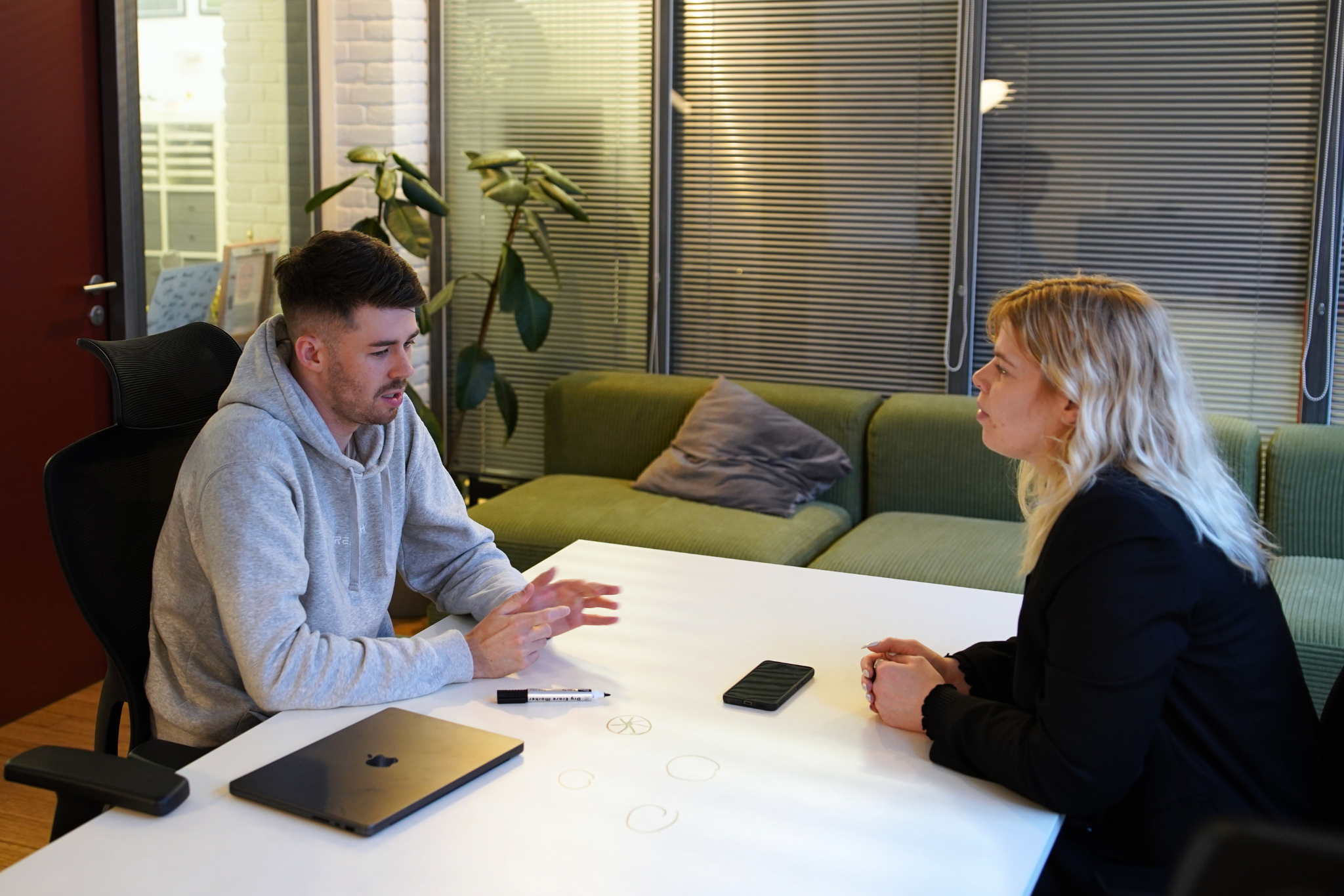
As Co-Founder of Prematch, Lukas Röhle is building one of Germany’s fastest growing digital communities around grassroots football. What began with a simple Instagram account has evolved into a platform connecting millions of players, teams and local football ecosystems.
As part of the Scale-up.NRW Community (Batch #4), Röhle shares his perspective on community driven growth, disciplined product development and the importance of focus while scaling platform businesses.
Lukas identifies one of the smartest early decisions in hindsight in how little Prematch initially built. Rather than investing heavily into technology from day one, the team focused on validating whether genuine demand existed within the community.
The first proof point came surprisingly early. A single Instagram account focused on one football league quickly attracted more than a thousand followers, revealing the scale of untapped demand within amateur football ecosystems. Instead of immediately building a complex platform, the team began manually testing engagement through WhatsApp interactions and simple feedback loops.
“We first launched an Instagram account for one football league and quite quickly it had more than 1,000 followers. That was when we started to realize the potential.”
For Lukas, the decisive insight was not just initial traction, but retention. Even before a real product existed, users kept returning and interacting consistently. That long term engagement gave the team the confidence to move forward, attract early investors and eventually commit fully to building Prematch.
Lukas sees Prematch’s growth strategy as fundamentally different from traditional mass market platform approaches. Rather than building one broad macro community, the company deliberately expanded through tightly connected local ecosystems.
The platform first focused on individual leagues, then regions, before gradually expanding into broader amateur and youth football segments. Each expansion step was designed to strengthen density and engagement within existing communities before moving outward.
“We are essentially bundling many micro communities into one macro community, rather than trying to build a macro community from day one.”
In Lukas’s view, this dynamic creates a powerful network effect because users already know each other offline through teams, leagues and competitions. Prematch therefore does not need to create entirely new behaviors, but instead digitizes existing relationships and conversations.
One of the defining principles behind Prematch’s early development was maintaining resource discipline for as long as possible. Lukas believes that operating with limited resources forced the team to focus intensely on the product’s core value instead of scaling prematurely.
Rather than raising large amounts of capital before validating the product, the team intentionally delayed external financing and concentrated on building proof points first.
“We always wanted to build something first and only then raise investment based on the results.”
For Lukas, this approach created a particularly strong connection to the product and the community’s actual needs. By taking time to validate user behavior before scaling the technical infrastructure, the team was able to build with greater clarity and conviction, creating a more resilient foundation for long term growth.
As Prematch scaled, Lukas sees prioritization as one of the company’s central operational challenges. In a fast moving environment with constant new opportunities, maintaining focus requires deliberate structures and continuous reassessment.
The company therefore relies heavily on strategic headlines, annual priorities and OKR frameworks that guide decision making across all teams. Every initiative is expected to align with clearly defined objectives.
“If a new opportunity comes in, another topic has to be deprioritized. You cannot just continuously add priorities without removing others.”
At the same time, Lukas emphasizes the importance of midterm reassessments. Rather than rigidly following annual plans, the team regularly reevaluates goals and is willing to narrow focus even further when new learnings emerge. In his view, sustainable scaling depends less on doing more and more on consistently protecting strategic clarity.
For Lukas, the company culture is not as an abstract concept, but a operational framework that directly shapes performance and collaboration. At Prematch, three core values define this foundation: ambition, togetherness and positivity.
These values influence hiring decisions, performance reviews and day to day collaboration across the company. What stands out particularly is the emphasis on collective rather than individual success.
“We define ourselves through shared goals, not individual achievements.”
This principle becomes especially visible in the company’s external presence. Whether supporting hiring initiatives, partnerships or brand collaborations, employees actively contribute beyond their own functional responsibilities because they understand the broader impact on the company’s success.
For Lukas, sustaining this mindset requires continuous communication and transparency. Teams need to understand not only what they are contributing to, but also why their involvement creates value for the organization as a whole.
Lukas’s perspective highlights an important lesson for community driven businesses. Sustainable growth rarely starts with scale itself. It starts with deeply understanding existing user behavior, validating demand with discipline and expanding ecosystem by ecosystem rather than chasing growth prematurely.
With this focused approach, Prematch has successfully built one of the leading football communities in Germany and attracted major partners such as Nivea Men and other well known brands that want to engage authentically with highly engaged fan communities.
For the Scale-up.NRW ecosystem, Prematch demonstrates how strong communities, operational focus and a collaborative culture can become powerful long term growth drivers.